What is Tapis?
The Tapis is a costume indigenous to the Kalinga and Apayao generally refer to a single rectangular piece of cloth one wraps around oneself as clothing, but usually specifically applies to a colorful hand-woven wraparound skirt which was commonly used by women throughout the Philippines before the arrival of Spanish colonizers, and which is still used today as part of the Maria Clara gown and also by culturally conservative tribes.
The tapis worn by the Cordilleran women of Northern Luzon, known locally as the alampay, are the most prominent example.[1]

It is worn by wrapping the cloth around one’s waist and holding the ends together with the use of a tightly tied sash. It generally reaches down to knee length, and the weaving pattern of tapis describes the culture and temperament of the wearer’s tribe.[2]
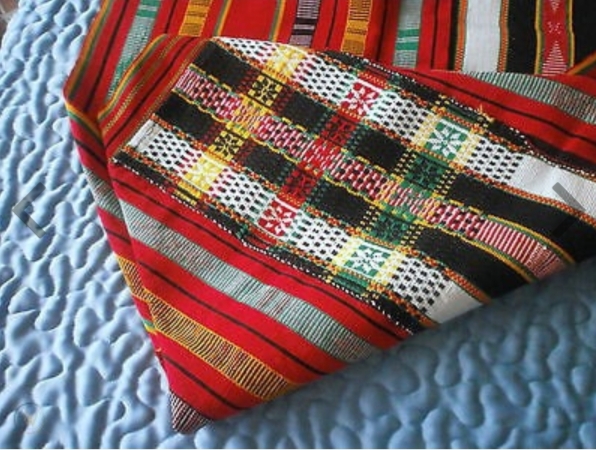
The mountainous region of Central Cordillera in northern Luzon is home to a large number of indigenous communities. Their fierce self-determination and geographic isolation provided relative protection from the cultural influences of Spanish colonisation. However, their art did not remain unchanged. Communities retained forms which were useful and meaningful, abandoned others and created new forms to meet new purposes – a tradition that has continued into 21st century.
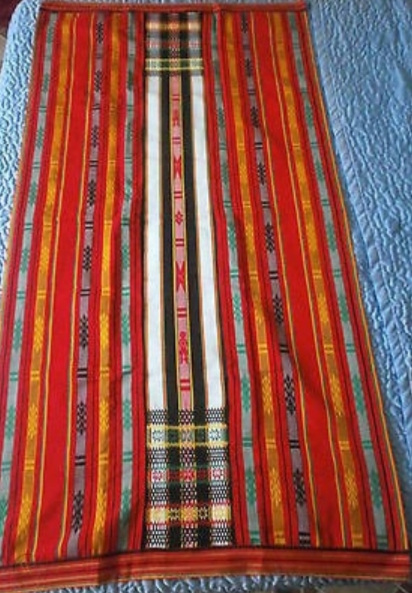
The Tapis has been in use in the Philippine archipelago since at least the indigenous period that came before the arrival of European colonists. Those colonists would take note of this particular mode of dress, considering it immodest. Spanish chroniclers from the early period noted that this mode of dress remained common on many islands despite Spanish efforts to introduce what they considered more suitable clothing. The felt that the tight profile of the tapis on a female wearer was revealing, and made even worse by the often sheer fabric of the cloth. One noted that the tapis became even more revealing whenever the wearer was caught in the rain, or had just taken a bath. The locals, however, did not consider the revealing properties of the tapis to be immodest.[3] Among the lowland peoples who came under the full influence of the Spanish, this would soon change as Christianization and Hispanization forced a much more conservative cultural imperialism, and along with it, a mode of dress that emphasized ethnocentricchauvinist christian-colonial sense of subjective modesty
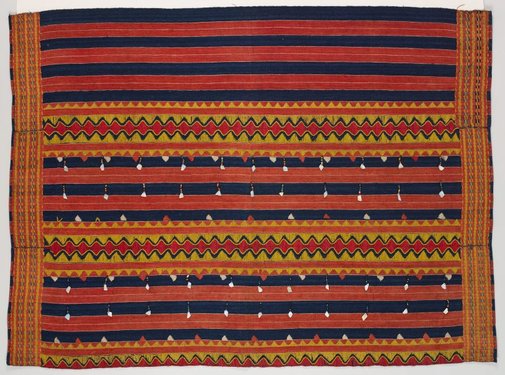
The basic dress for women across the Cordillera region consists of a skirt which is sometimes complemented with a jacket. While many motifs and colours are shared across the region, Kalinga clothing is particularly brightly coloured and is often dominated by bands of fiery red. This type of wraparound skirt is generally known as tapis in the Tagalog language and as kain to the Kalinga. It is characterised by horizontal stripes bordered by decorated panels along the joins and edges. In typical fashion, this example is further embellished with embroidery, beads and mother-of-pearl shells. The shells, which were an imported novelty for mountainous communities like the Kalinga, are attached so has to move and reflect light. This adds a dynamic element to the overall design of the skirt.
In every traditional art in our country should be keep, preserve and acknowledge. It promotes the culture and heritage of our nation. It also the way in which we can show the love and gratitude to our ancestor for their hardwork and unique talents.
Sources:
📌-https://www.artgallery.nsw.gov.au/collection/works/207.2005/
📌-https://www.worthpoint.com/worthopedia/tapis-filipino-kalinga-handwoven-519020546
📌-https://en.m.wikipedia.org/wiki/Tapis_(Philippine_clothing)


 Site Title